Journey Trail Notes Storing Words, Understanding Sentences
How Orthographic Mapping and Syntax Support Fluent Reading
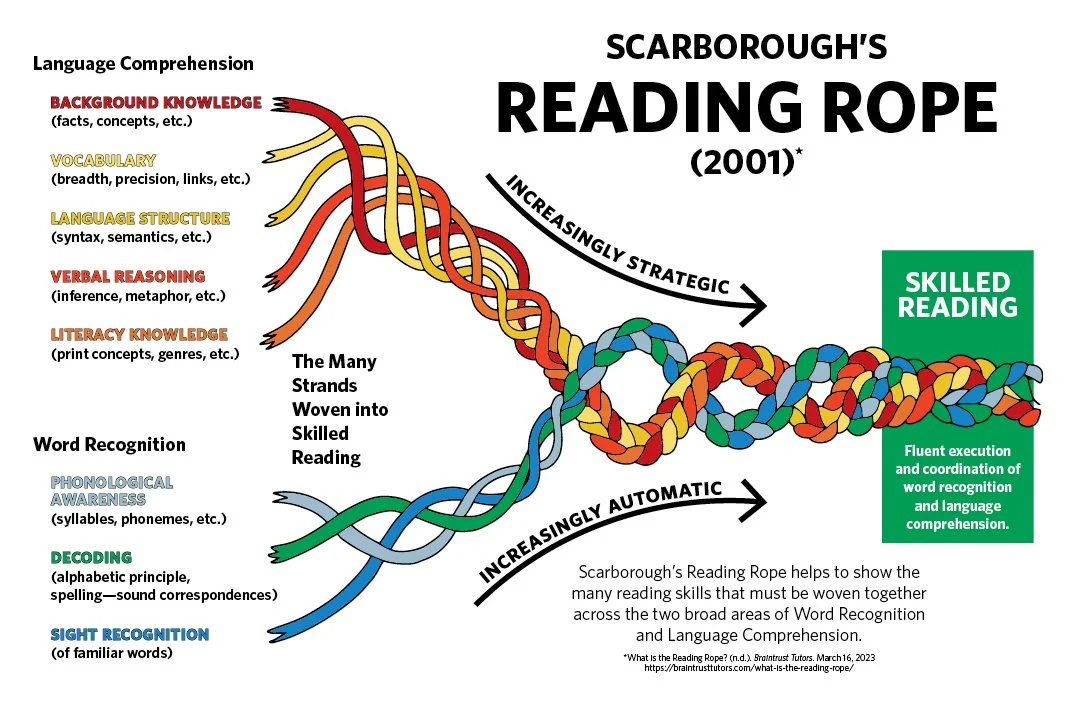
The last two blogs established the foundational anchors of Scarborough’s Reading Rope and examined the interaction of phonics and vocabulary; now, this blog turns to the next stage of reading development, where efficiency in word recognition and precision in sentence processing become essential.
As children become more accurate decoders, reading success depends on efficiency and meaning. Skilled readers recognize familiar words instantly and interpret increasingly complex sentences with ease. Scarborough’s Reading Rope captures this progression through the strands of orthographic mapping and syntax, which work together to support fluent, meaningful reading.
Orthographic mapping strengthens word recognition by storing written words permanently in memory. Syntax strengthens comprehension by helping readers understand how words function together in sentences. Both are essential for fluent reading.
Literacy Landmark
Spotlighting strategies and research to support all adults who are a part of a child’s reading growth.
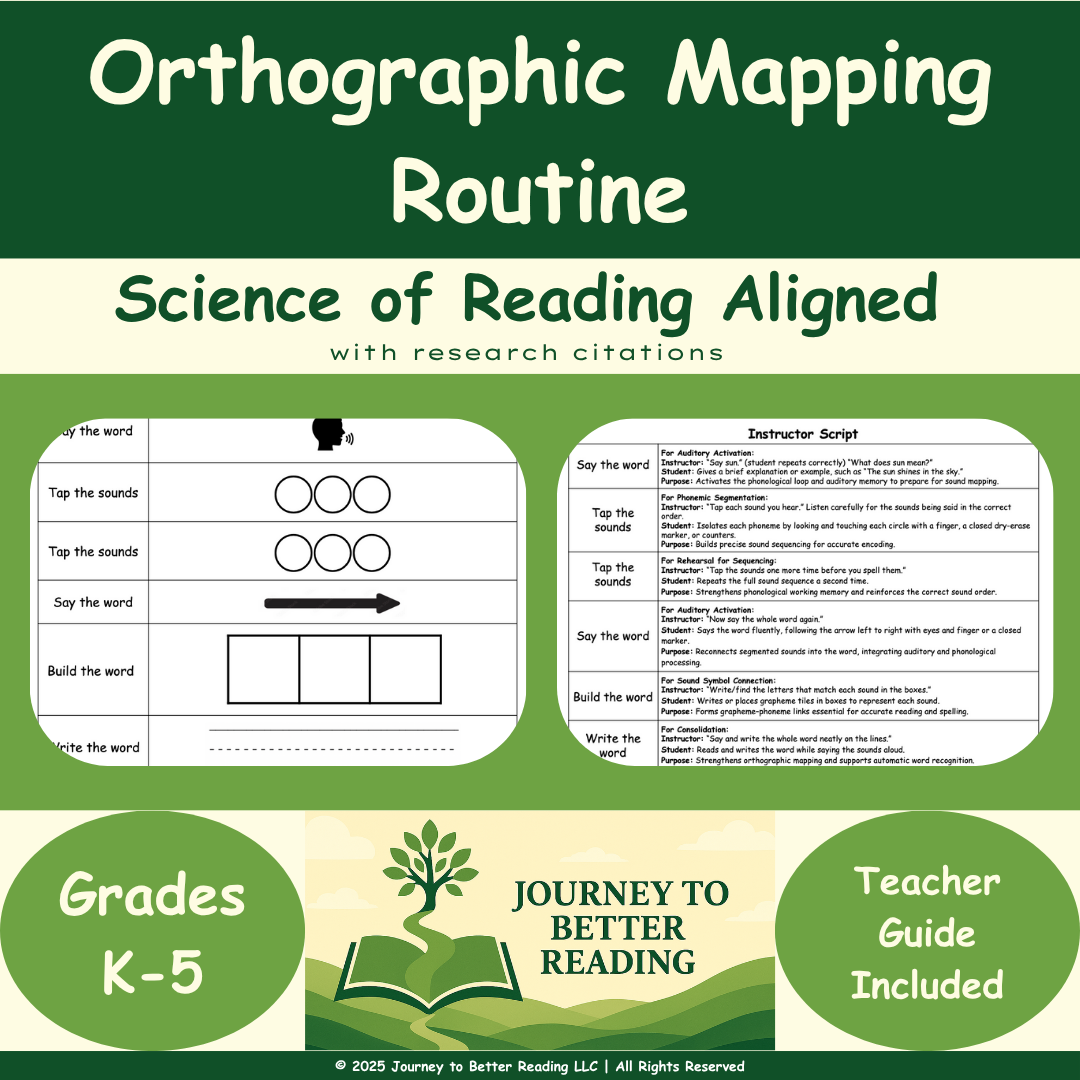
Orthographic mapping is the process through which readers form permanent connections between sounds and spellings. Words are not memorized visually. They are remembered because phonemes have been accurately mapped to graphemes through repeated, successful decoding.
Syntax refers to sentence structure. Comprehension depends on understanding how word order, phrases, and clauses convey meaning. Even when individual words are known, complex syntax can disrupt understanding if it is not explicitly taught.
Key research insight:
Research suggests that strong phonemic proficiency facilitates orthographic mapping, while explicit instruction in sentence structure enhances reading comprehension. Efficient word recognition and syntactic understanding develop together.
Resource Roadmap
Offering practical books, guides, and downloadable resources that families, teachers, and homeschoolers can use right away.
Research-aligned resources that explain and support these strands:
Equipped for Reading Success (David Kilpatrick)
Clarifies the role of phonemic proficiency in orthographic mapping and fluent word recognition.
The Writing Revolution (Judith Hochman & Natalie Wexler)
Provides practical strategies for strengthening syntax through sentence-level instruction.
🖋️ These resources are not sponsored and reflect evidence-based practice.
Practical Pathways for Supporting Reading Development
All strategies below can be used at home, in classrooms, or in homeschool settings.
Trail Tots (Birth–5)
Focus: Early sound awareness and sentence exposure
Try this:
Play oral blending and segmenting games during books and daily routines.
Read aloud frequently and model rich, complete sentences.
Invite children to repeat or finish patterned sentences in familiar stories.
Why it works:
Builds early phonemic awareness while exposing children to sentence structure and fluent language.
Trailblazers (Grades K–3)
Focus: Mapping words and understanding sentence meaning
Try this:
Stretch sounds and write letters to map words explicitly.
Analyze high-frequency words by identifying regular and irregular spellings.
Discuss who is doing what in a sentence and reread with expression.
Why it works:
Supports automatic word recognition while strengthening sentence-level comprehension.
Trail Masters (Grades 4–8)
Focus: Efficient word storage and complex sentence comprehension
Try this:
Teach strategies for decoding and storing multisyllabic words.
Break complex sentences into meaningful chunks.
Use sentence combining and expanding to explore how structure shapes meaning.
Why it works:
Strengthens fluency and comprehension by integrating word recognition with syntactic understanding.
How to Use This Across Settings
Parents: Focus on short sound-based activities paired with talk about sentence meaning.
Teachers: Integrate orthographic mapping and sentence work into reading and writing instruction.
Homeschoolers: Use hands-on word study and discussion to reinforce structure and meaning.
Why this matters
Fluent reading depends on instant word recognition and accurate sentence interpretation. When orthographic mapping and syntax are intentionally taught together, students gain the efficiency and understanding needed for complex reading tasks.
Need help getting started with Orthographic Mapping? Check this out:
Looking Down The Trail
In the next blog, you’ll find an examination of how fluency, verbal reasoning, and literacy knowledge integrate earlier skills to support comprehension across extended texts.