Journey Trail Notes Building the Code, Building the Words
How Phonics and Vocabulary Work Together
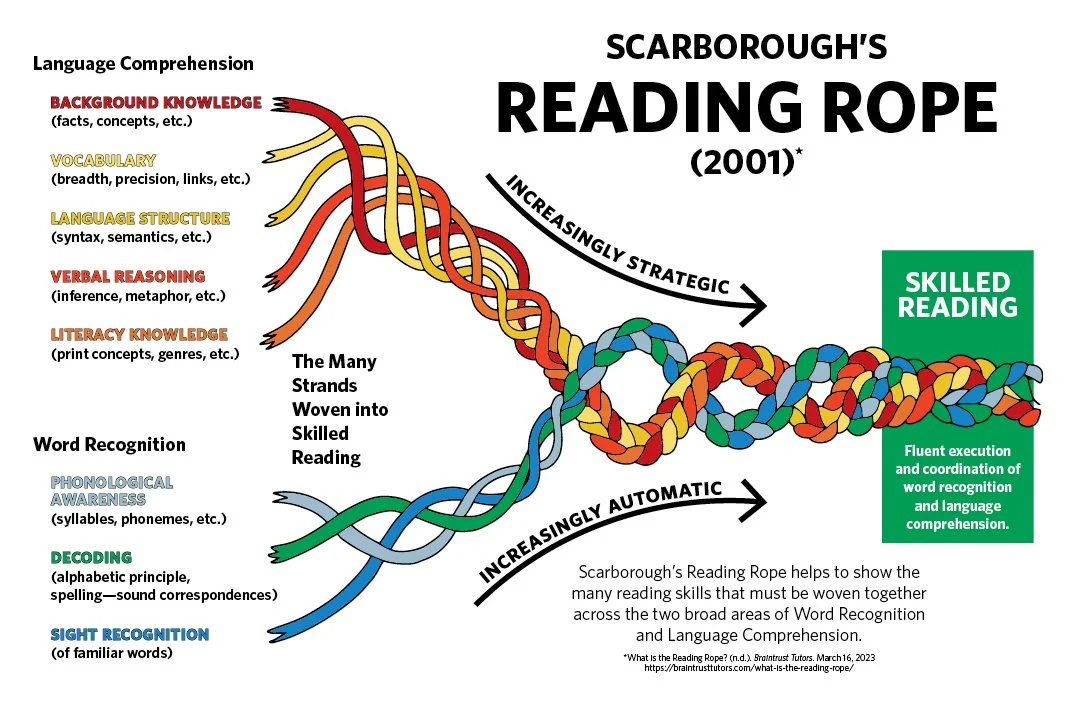
In the previous blog, phonemic awareness and background knowledge were identified as the foundational anchors of Scarborough’s Reading Rope. This blog will cover two central strands, phonics and vocabulary, that interact to support fluent, meaningful reading.
Scarborough’s Reading Rope shows that skilled reading develops through the interaction of word recognition and language comprehension. Within this framework, phonics and vocabulary sit at the center, working together to help readers accurately decode words and understand their meaning.
Phonics provides the reliable code readers need to unlock unfamiliar words. Vocabulary gives those words meaning. When these strands grow together, readers move more efficiently from print to understanding.
Literacy Landmark
Spotlighting strategies and research to support all adults who are a part of a child’s reading growth.
Phonics instruction teaches how written language represents speech sounds and meaningful word parts. English spelling reflects both sound and meaning, making explicit, systematic phonics instruction essential.
Vocabulary development involves more than learning definitions. It includes depth of understanding, connections between concepts, and flexible use of words across contexts. Vocabulary and background knowledge grow through direct instruction, repeated exposure, and meaningful language use.
Key research insight:
Research consistently shows that systematic phonics instruction improves word recognition and spelling, while explicit vocabulary and knowledge-building instruction strengthen comprehension. When phonics and vocabulary are taught together, reading becomes more accurate, fluent, and meaningful.
Resource Roadmap
Offering practical books, guides, and downloadable resources that families, teachers, and homeschoolers can use right away.
Anchor Text: Building Meaning Through Words
Bringing Words to Life by Beck, McKeown, & Kucan
This text provides a clear, research-based framework for teaching vocabulary in a deep, intentional, and cumulative way. Grounded in decades of cognitive and literacy research, Bringing Words to Life introduces the concept of robust vocabulary instruction, emphasizing word selection, repeated exposure, student-friendly explanations, and meaningful use across contexts.
Rather than treating vocabulary as a list to be memorized, the authors position word knowledge as a driver of language comprehension, reading comprehension, and long-term academic success.
Why this helps:
If you recognize that “knowing words matters” but are unsure how vocabulary instruction actually supports comprehension, this book clarifies what to teach, why it matters, and how to implement instruction that sticks. It makes explicit the often-invisible connection between oral language, background knowledge, and skilled reading.
Listen and Learn: Vocabulary and Language Comprehension Explained
Sold a Story — Vocabulary and Comprehension Episodes
This investigative podcast is widely known for its exploration of reading instruction, but several episodes and companion discussions explicitly address vocabulary, language comprehension, and instructional coherence. Through interviews with researchers and practitioners, it highlights how weak vocabulary instruction undermines comprehension even when decoding appears strong.
Why this helps:
This resource reinforces the message that phonics alone is not enough. It helps listeners understand how vocabulary and language comprehension fit into the broader reading system and why neglecting these strands creates fragile readers. The podcast format also makes the research more accessible to families and educators who prefer audio learning.
🖋️ These resources are not sponsored and were selected because they reflect well-established, evidence-based practice and offer clear entry points into understanding how vocabulary and language comprehension contribute to skilled reading across ages and settings.
Practical Pathways for Supporting Reading Development
All strategies below can be used at home, in classrooms, or in homeschool settings.
Trail Tots (Birth–5)
Focus: Early sound awareness and word learning
Try this:
Talk throughout the day about objects, actions, and experiences.
Read aloud frequently, naming unfamiliar words and explaining ideas.
Play sound-based games that emphasize beginning sounds and simple word families.
Why it works:
Builds early phonological awareness while expanding vocabulary and conceptual knowledge.
Trailblazers (Grades K–3)
Focus: Connecting phonics and meaning
Try this:
Practice phonics patterns through word building, blending, and decodable texts.
Teach high-frequency words through spelling analysis and orthographic mapping rather than visual memorization.
Highlight and discuss new vocabulary during read-alouds and content lessons.
Why it works:
Strengthens automatic word recognition while supporting vocabulary growth and comprehension.
Trail Masters (Grades 4–8)
Focus: Advanced word reading and vocabulary depth
Try this:
Teach prefixes, suffixes, and roots to support decoding and meaning.
Break multisyllabic words into syllables and meaningful parts during reading.
Reinforce vocabulary through discussion, writing, and content-rich reading.
Why it works:
Supports fluent access to complex text while deepening understanding through language and knowledge.
How to Use This Across Settings
Parents: Pair morphology practice with conversation and word exploration.
Teachers: Integrate morphology and vocabulary instruction within the same lesson block.
Homeschoolers: Use consistent, cumulative routines that connect sound, print, and meaning.
Why this matters
Phonics allows readers to access words. Vocabulary allows them to understand what they read. When these strands grow together, reading becomes more accurate, fluent, and meaningful.
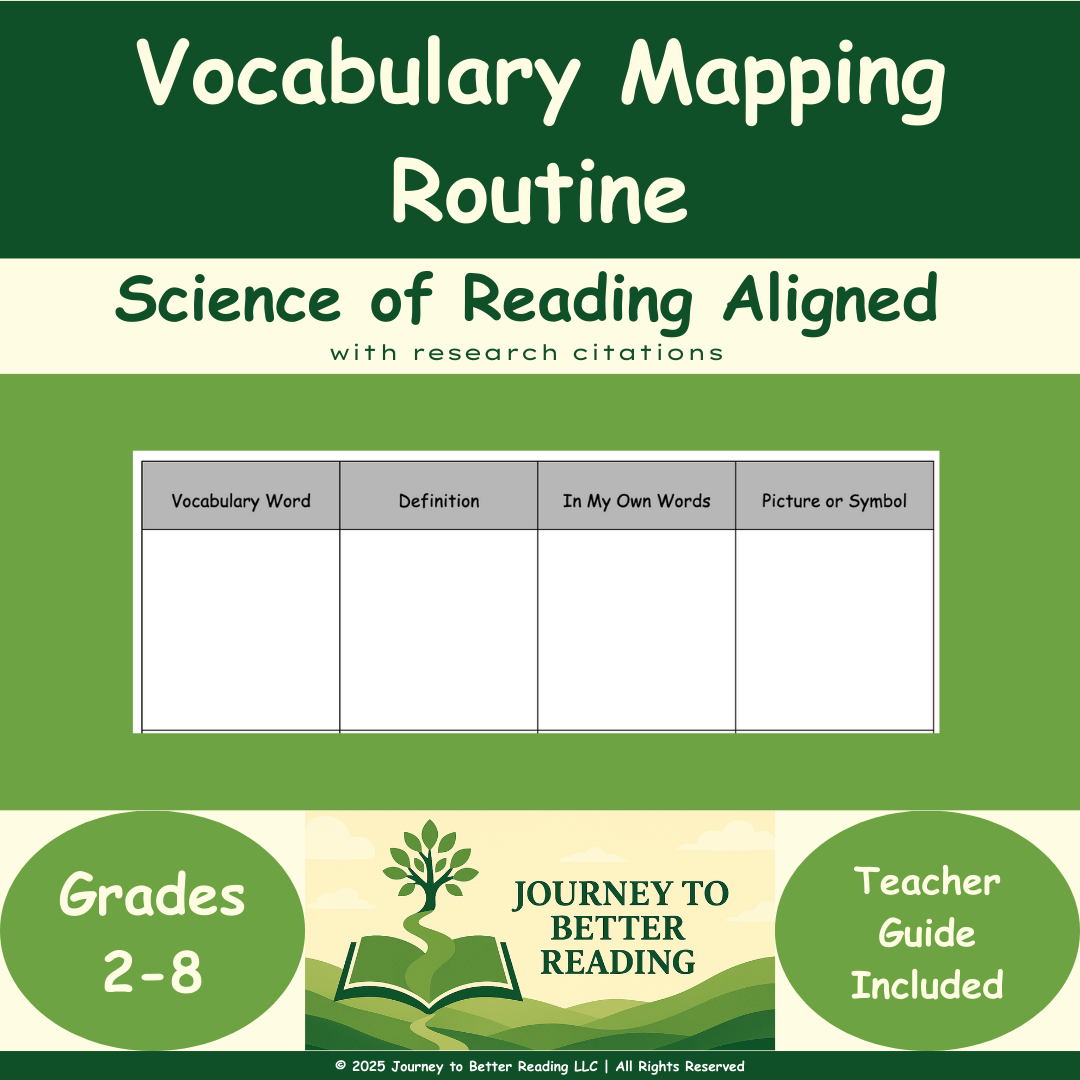
Need a Vocabulary Activity?
Check out this FREE Resource:
Looking Down The Trail
In the next blog, you’ll find a discussion of how orthographic mapping and syntax support efficiency and structure as reading becomes more fluent.