Journey Trail Notes Game Time
Play to Learn:
How Simple Games Strengthen the Language Comprehension Side of Reading
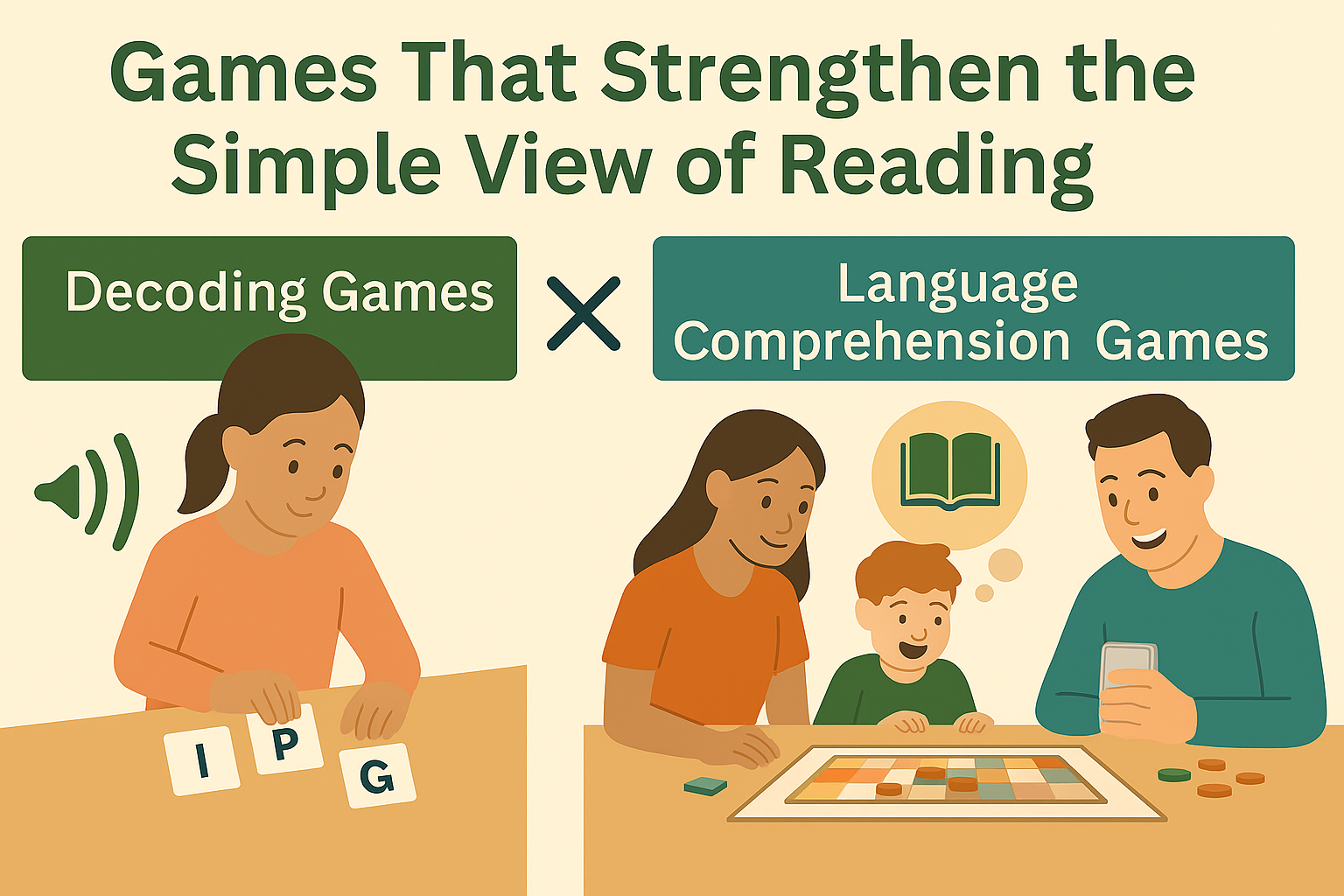
Reading comprehension develops wherever children engage in meaningful talk, problem-solving, and play. Simple games strengthen the language comprehension side of reading by building vocabulary, reasoning, inferencing, and narrative understanding. This post explores the research behind play and shares practical, low-prep games that parents, teachers, and homeschoolers can use immediately.
Literacy Landmark
Spotlighting strategies and research to support all adults who are a part of a child’s reading growth.
Research consistently shows that games support the cognitive and linguistic foundations of reading comprehension, including oral language, reasoning, motivation, and narrative development.
Key research insight:
Dickinson and Tabors (2001) found that children who regularly engaged in rich, conversational play developed significantly stronger vocabulary and later reading comprehension than peers with fewer language-rich interactions.
This work highlights that play is not peripheral to literacy. It is a primary context in which language and thinking develop.
Resource Roadmap
Offering practical books, guides, and downloadable resources that families, teachers, and homeschoolers can use right away.
Here is a practical, research-aligned resource that translates theory into everyday practice:
Einstein Never Used Flashcards (Hirsh-Pasek & Golinkoff)
This book explains how simple, low-prep games and playful interactions build vocabulary, reasoning, and flexible thinking. It offers concrete examples that families and educators can use immediately, without specialized materials.
🖋️ I have no affiliation or compensation associated with this recommendation.
Practical Play Pathways for Reading Development
All activities below can be used at home, in classrooms, or in homeschool settings by adjusting group size and materials.
Trail Tots (Birth–5)
Sound & Letter Play: Letter Go Fish
Use index cards, sticky notes, or letter tiles. Ask for sounds first (“Do you have /m/?”), then letter names, then objects that start with that sound.
Why it works:
Builds phonological awareness, letter–sound connections, and early decoding readiness.
Language & Talk: Spot It! or Picture Bingo
Have children describe, compare, and categorize images before making a match.
Why it works:
Strengthens vocabulary, oral language, categorization, and expressive language.
Trailblazers (Grades K–3)
Word Building: Boggle Variations
Generate words, then extend learning by:
Adding suffix -s
Sorting rhyming words
Using words in oral or written sentences
Why it works:
Reinforces phonics patterns, early morphology, and vocabulary development.
Story & Meaning: Story Boggle
Use generated words to create short stories with a beginning, middle, and end.
Why it works:
Supports narrative structure, sequencing, and comprehension.
Trail Masters (Grades 4–8)
Reasoning & Inference: Inference Detectives
Provide clues that imply an idea without stating it directly. Students identify and justify their reasoning.
Why it works:
Strengthens inferencing, background knowledge, and verbal reasoning.
Vocabulary & Meaning: Dixit, Codenames, or Scattergories
Connect cards or words to themes, characters, or concepts from current reading.
Why it works:
Builds semantic networks, figurative language, and flexible thinking.
How to Use This Across Settings
Parents: Choose one game and play for 10–15 minutes while talking through thinking.
Teachers: Use as a literacy warm-up, station activity, or discussion starter.
Homeschoolers: Rotate activities weekly to build consistent, low-prep routines.
Why this matters
Games do not replace reading instruction. When used intentionally, they prepare the language, reasoning, and motivation systems that reading comprehension depends on.