

Journey Trail Notes: Laying the Foundations
Welcome to the Journey To Better Reading Trail Notes Blog! This blog will make it easier for parents, teachers, and homeschoolers to find practical tools grounded in research to ensure that every moment you spend trying to improve reading does just that. We will start with one of the most important topics for anyone supporting a child’s reading growth: how the brain actually learns to read. Understanding this process helps parents, teachers, and homeschoolers know why certain approaches work and what to prioritize. Whether you teach in a classroom, guide learning at home, or support readers as a caregiver, you’ll find insights here that make reading instruction clearer and more purposeful.
Hearing the Sounds, Knowing the World
After examining the Simple View of Reading as a foundational model in the last couple of blogs, it is useful to move toward a framework that captures how reading develops over time and why instruction must be both systematic and expansive.
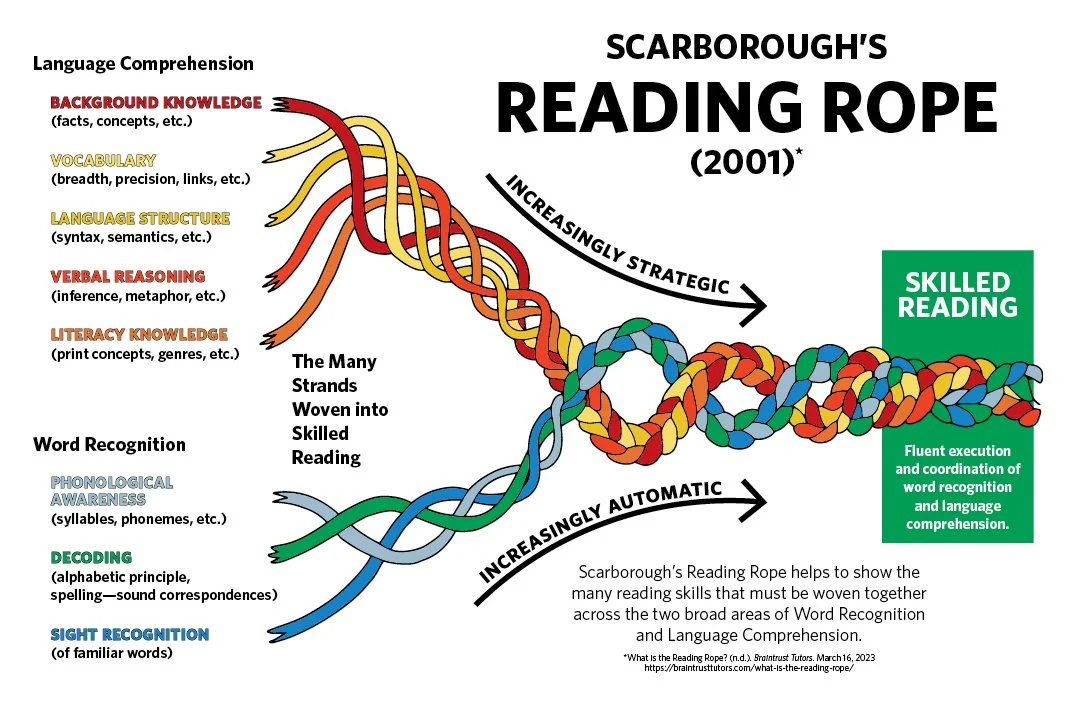
Scarborough’s Reading Rope expands on the Simple View of Reading by showing how multiple strands of skill work together over time. The lower strands represent word recognition, which becomes increasingly automatic. The upper strands represent language comprehension, which becomes increasingly strategic. Skilled reading emerges when these strands are tightly woven together.
Before exploring each strand in depth, it’s essential to understand the foundations on which the Rope rests:
Phonemic awareness for word recognition
Background knowledge for language comprehension
Hearing the sounds and knowing the world anchor every later strand of reading development.
Literacy Landmark
Spotlighting strategies and research to support all adults who are a part of a child’s reading growth.
Phonemic awareness, the ability to hear and manipulate individual sounds in spoken language, is the foundation of word recognition. Without it, children struggle to connect speech to print.
Background knowledge is the foundation of language comprehension. Even fluent decoding cannot support comprehension if readers lack the necessary concepts and experiences to make sense of the text.
Key research insight:
Scarborough’s Reading Rope demonstrates that reading success depends on the integration of these strands. When foundations are weak, later instruction cannot compensate. Learn more about Scarborough’s Reading Rope with this video.
Resource Roadmap
Offering practical books, guides, and downloadable resources that families, teachers, and homeschoolers can use right away.
Anchor Text: From Research to Action
Reach All Readers by Anna Geiger
A research-aligned, practitioner-friendly guide that connects foundational reading science, including the Simple View of Reading and Scarborough’s Reading Rope, with clear instructional routines and strategies. This book helps adults understand why specific reading skills are essential and how to support them in both the classroom and at home.
Why this helps:
For readers who understand that phonemic awareness and background knowledge are important but are unsure how to translate this into effective instruction, this book provides a coherent bridge from theory to practice.
Listen and Learn: Foundations Explained
The Simple View of Reading and Scarborough’s Reading Rope
This podcast is available in both written form and an accompanying discussion. It breaks down the Simple View and Scarborough’s Rope in a way that is accessible to educators, parents, and caregivers.
Why this helps:
This link provides a concise, multimedia-friendly explanation of the frameworks discussed in this blog, making it easier to revisit and internalize the core concepts on the go.
🖋️ These resources are not sponsored and were selected because they reflect evidence-based practice and provide accessible entry points into reading science that supports instruction and understanding across ages and settings.
Practical Foundations Across Ages
All strategies below can be used at home, in classrooms, or in homeschool settings with minimal materials.
Trail Tots (Birth–5)
Focus: Phonological awareness and background knowledge
Try this:
Engage in rich conversation during daily routines (meals, errands, play).
Read aloud daily and talk about pictures, ideas, and events.
Play with sounds through rhymes, syllable clapping, and noticing beginning sounds.
Slowly blend simple words aloud (“/s/…/un/”) during play or reading.
Why it works:
Builds early sound awareness while expanding vocabulary and world knowledge, laying the neural foundation for later reading.
Trailblazers (Grades K–3)
Focus: Phonemic proficiency and growing knowledge
Try this:
Practice brief phonemic awareness activities by manipulating sounds:
adding: say cat - add /s/ to the beginning = scat
deleting: say cat - take away the /c/ sound = at
substituting: say cat - change the /c/ sound to /m sound = mat)
Reinforce phonics patterns through word reading, word building, and decodable texts.
Teach high-frequency words through sound analysis and orthographic mapping.
Use handwriting to strengthen sound–symbol integration.
Read aloud daily and discuss vocabulary, concepts, and meaning.
Why it works:
Strengthens automatic word recognition while expanding the language and knowledge needed for comprehension.
Trail Masters (Grades 4–8)
Focus: Advanced word reading and knowledge-driven comprehension
Try this:
Teach syllable types and vowel patterns for multisyllabic decoding.
Introduce prefixes, suffixes, and roots to support decoding and vocabulary growth.
Build vocabulary through morphology and semantic connections.
Use comprehension routines that emphasize summarizing, questioning, and inferencing.
Incorporate structured writing to strengthen syntax and text organization.
Why it works:
Supports fluent access to complex text while deepening meaning through the integration of language and knowledge.
How to Use This Across Settings
Parents: Focus on short, meaningful language moments paired with sound play.
Teachers: Integrate decoding and knowledge-building within the same lesson block.
Homeschoolers: Use consistent, cumulative routines that connect sound, print, and meaning.
Why this matters
Scarborough’s Reading Rope reminds us that reading instruction must be built from the ground up. When phonemic awareness and background knowledge are intentionally developed, the strands of reading can be woven into a strong, flexible rope that supports lifelong reading success.
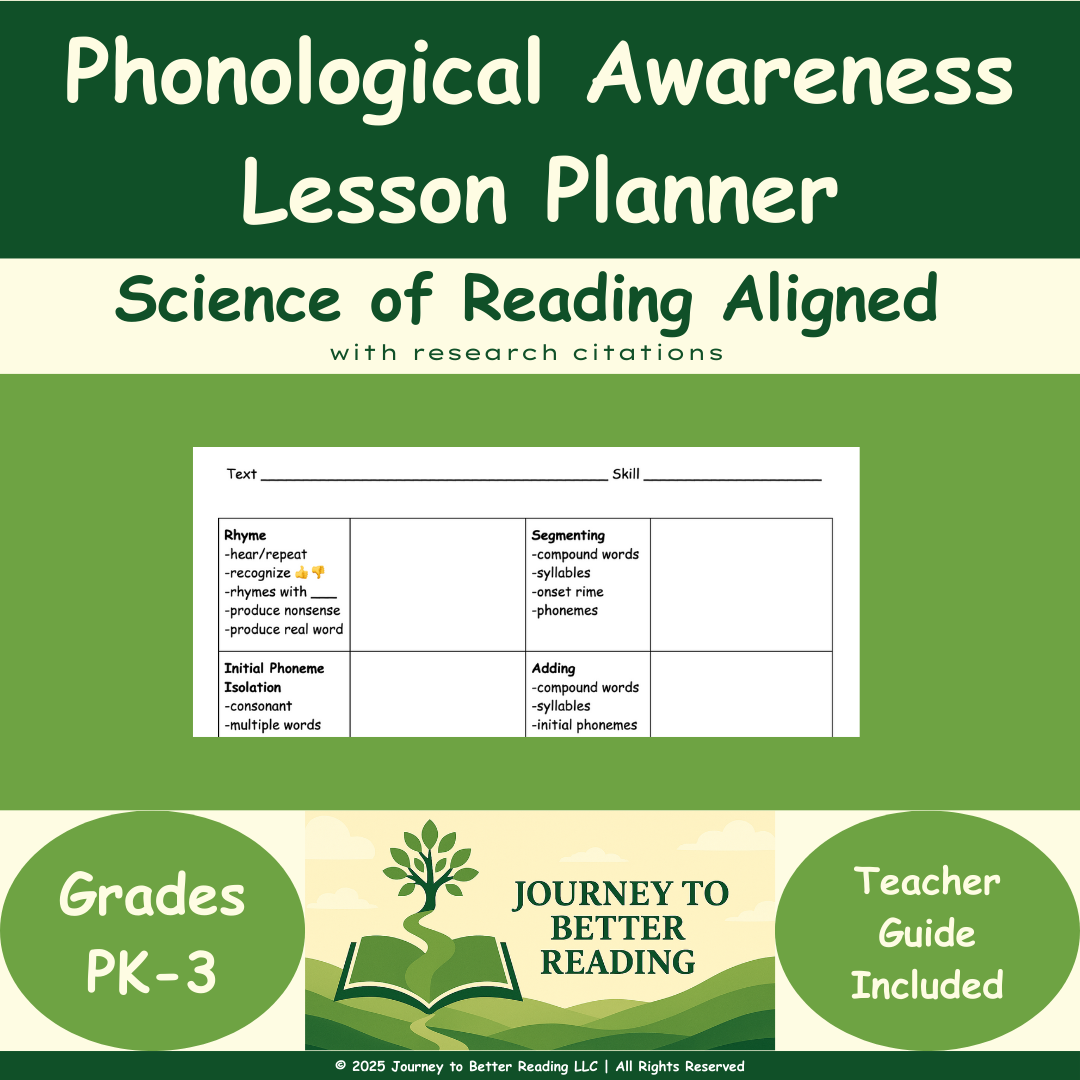
Need help getting started with Phonological Awareness Lesson Planning?
Check this out:
Looking Down The Trail
In the next blog, you’ll find an exploration of how phonics and vocabulary work together as part of Scarborough’s rope to connect accurate word reading with meaning.
Follow
Journey Trail Notes Game Time
Welcome to the Journey To Better Reading Trail Notes Blog! This blog will make it easier for parents, teachers, and homeschoolers to find practical tools grounded in research to ensure that every moment you spend trying to improve reading does just that. We will start with one of the most important topics for anyone supporting a child’s reading growth: how the brain actually learns to read. Understanding this process helps parents, teachers, and homeschoolers know why certain approaches work and what to prioritize. Whether you teach in a classroom, guide learning at home, or support readers as a caregiver, you’ll find insights here that make reading instruction clearer and more purposeful.
Play to Learn:
How Simple Games Strengthen the Language Comprehension Side of Reading
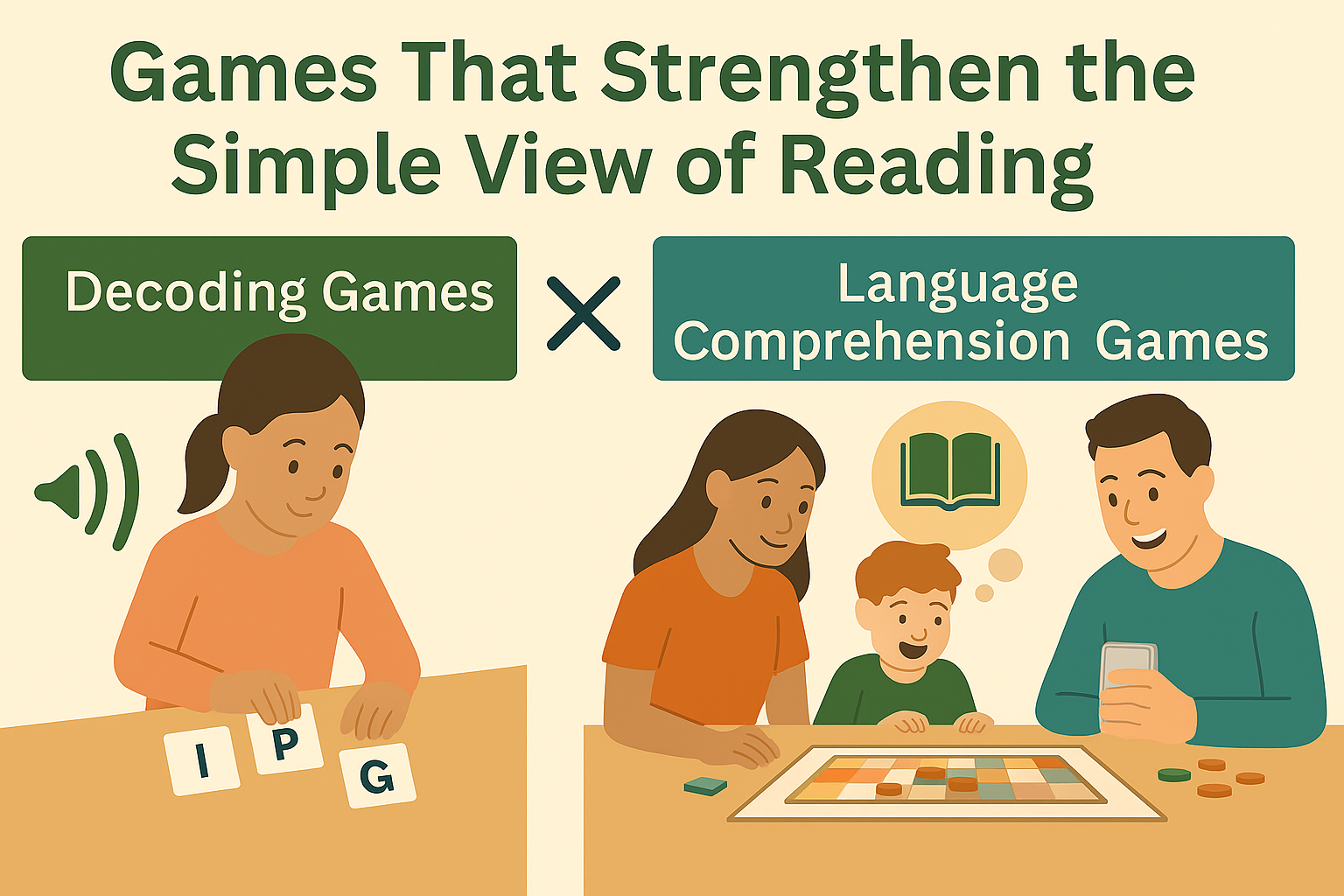
Reading comprehension develops wherever children engage in meaningful talk, problem-solving, and play. Simple games strengthen the language comprehension side of reading by building vocabulary, reasoning, inferencing, and narrative understanding. This post explores the research behind play and shares practical, low-prep games that parents, teachers, and homeschoolers can use immediately.
Literacy Landmark
Spotlighting strategies and research to support all adults who are a part of a child’s reading growth.
Research consistently shows that games support the cognitive and linguistic foundations of reading comprehension, including oral language, reasoning, motivation, and narrative development.
Key research insight:
Dickinson and Tabors (2001) found that children who regularly engaged in rich, conversational play developed significantly stronger vocabulary and later reading comprehension than peers with fewer language-rich interactions.
This work highlights that play is not peripheral to literacy. It is a primary context in which language and thinking develop.
Resource Roadmap
Offering practical books, guides, and downloadable resources that families, teachers, and homeschoolers can use right away.
Here is a practical, research-aligned resource that translates theory into everyday practice:
Einstein Never Used Flashcards (Hirsh-Pasek & Golinkoff)
This book explains how simple, low-prep games and playful interactions build vocabulary, reasoning, and flexible thinking. It offers concrete examples that families and educators can use immediately, without specialized materials.
🖋️ I have no affiliation or compensation associated with this recommendation.
Practical Play Pathways for Reading Development
All activities below can be used at home, in classrooms, or in homeschool settings by adjusting group size and materials.
Trail Tots (Birth–5)
Sound & Letter Play: Letter Go Fish
Use index cards, sticky notes, or letter tiles. Ask for sounds first (“Do you have /m/?”), then letter names, then objects that start with that sound.
Why it works:
Builds phonological awareness, letter–sound connections, and early decoding readiness.
Language & Talk: Spot It! or Picture Bingo
Have children describe, compare, and categorize images before making a match.
Why it works:
Strengthens vocabulary, oral language, categorization, and expressive language.
Trailblazers (Grades K–3)
Word Building: Boggle Variations
Generate words, then extend learning by:
Adding suffix -s
Sorting rhyming words
Using words in oral or written sentences
Why it works:
Reinforces phonics patterns, early morphology, and vocabulary development.
Story & Meaning: Story Boggle
Use generated words to create short stories with a beginning, middle, and end.
Why it works:
Supports narrative structure, sequencing, and comprehension.
Trail Masters (Grades 4–8)
Reasoning & Inference: Inference Detectives
Provide clues that imply an idea without stating it directly. Students identify and justify their reasoning.
Why it works:
Strengthens inferencing, background knowledge, and verbal reasoning.
Vocabulary & Meaning: Dixit, Codenames, or Scattergories
Connect cards or words to themes, characters, or concepts from current reading.
Why it works:
Builds semantic networks, figurative language, and flexible thinking.
How to Use This Across Settings
Parents: Choose one game and play for 10–15 minutes while talking through thinking.
Teachers: Use as a literacy warm-up, station activity, or discussion starter.
Homeschoolers: Rotate activities weekly to build consistent, low-prep routines.
Why this matters
Games do not replace reading instruction. When used intentionally, they prepare the language, reasoning, and motivation systems that reading comprehension depends on.
Journey Trail Notes Simple View of Reading
Welcome to the Journey To Better Reading Trail Notes Blog! This blog will make it easier for parents, teachers, and homeschoolers to find practical tools grounded in research to ensure that every moment you spend trying to improve reading does just that. We will start with one of the most important topics for anyone supporting a child’s reading growth: how the brain actually learns to read. Understanding this process helps parents, teachers, and homeschoolers know why certain approaches work and what to prioritize. Whether you teach in a classroom, guide learning at home, or support readers as a caregiver, you’ll find insights here that make reading instruction clearer and more purposeful.
Welcome to the Journey To Better Reading Trail Notes Blog! This blog will make it easier for parents, teachers, and homeschoolers to find practical tools grounded in research to ensure that every moment you spend trying to improve reading does just that. We will start with one of the most important topics for anyone supporting a child’s reading growth: how the brain actually learns to read. Understanding this process helps parents, teachers, and homeschoolers know why certain approaches work and what to prioritize. Whether you teach in a classroom, guide learning at home, or support readers as a caregiver, you’ll find insights here that make reading instruction clearer and more purposeful.
Literacy Landmark
Spotlighting strategies and research to support all adults who are a part of a child’s reading growth.
Reading does not develop naturally in the brain. Children must build new neural connections that link speech sounds, print, and meaning. Understanding how this process works helps parents, teachers, and homeschoolers know what to prioritize and why certain approaches are effective. One of the most influential frameworks explaining this process is the Simple View of Reading. A fantastic place to begin to understand reading development better is by watching this short video, “How the Brain Learns to Read.”
The Simple View of Reading (Gough & Tunmer, 1986) explains that reading comprehension depends on two essential components:
Decoding × Language Comprehension = Reading Comprehension
Both components must be developed intentionally. If either decoding or language comprehension is weak, reading breaks down.
Key research insight:
Decades of neuroscience and reading research show that explicit, structured instruction supports the brain in forming the sound–symbol–meaning connections required for fluent reading. This is why approaches grounded in phonics, vocabulary, and rich discussion are effective, especially for struggling readers.
Resource Roadmap
Offering practical books, guides, and downloadable resources that families, teachers, and homeschoolers can use right away.
A foundational, research-aligned resource for understanding how reading develops:
Speech to Print by Louisa Moats
This book explains the speech and language foundations of reading, clarifying why explicit instruction in sounds, letters, and word structure is critical for reading success across ages.
🖋️ This recommendation is not sponsored and reflects evidence-based practice.
Practical Pathways for Supporting Reading Development
All strategies below can be used at home, in classrooms, or in homeschool settings with minimal materials.
Trail Tots (Birth–5)
Try “Repeat and Extend.”
When a child says a single word (e.g., cup), repeat it slowly by sound, then blend it, and extend the language: “Yes, a blue cup with cold water.”
Why it works:
Builds phonological awareness while expanding vocabulary and sentence understanding.
Trailblazers (Grades K–3)
Blend one word during reading.
Pause during story time to blend a word aloud (“/s/…/ă/…/t/ → sat”), then use it in a sentence and ask a simple W-question.
Why it works:
Strengthens decoding pathways while reinforcing meaning and comprehension.
Trail Masters (Grades 4–8)
Be a word detective.
Break multisyllabic words into meaningful parts (e.g., con + struct). Discuss how each part contributes to meaning.
Why it works:
Supports accurate decoding, vocabulary growth, and deeper comprehension through morphology.
How to Use This Across Settings
Parents: Use brief, focused language moments during reading or daily routines.
Teachers: Integrate decoding and language work within the same lesson block.
Homeschoolers: Build consistent routines that connect sound work, reading, and discussion.
Why this matters
Reading instruction is most effective when it aligns with how the brain learns to read. When decoding and language comprehension are intentionally developed together, students gain stronger, more sustainable reading skills.