

Journey Trail Notes Poetry and the Reading Rope: Integrating All Strands of Skilled Reading
Welcome to the Journey To Better Reading Trail Notes Blog! This blog will make it easier for parents, teachers, and homeschoolers to find practical tools grounded in research to ensure that every moment you spend trying to improve reading does just that. We will start with one of the most important topics for anyone supporting a child’s reading growth: how the brain actually learns to read. Understanding this process helps parents, teachers, and homeschoolers know why certain approaches work and what to prioritize. Whether you teach in a classroom, guide learning at home, or support readers as a caregiver, you’ll find insights here that make reading instruction clearer and more purposeful.
Poetry is often treated as enrichment. Something to explore after “real reading” is done. In reality, poetry may be one of the most instructionally powerful text types we can use.
When students engage with poetry, they are not practicing a single skill. They are coordinating multiple systems simultaneously. Sound, structure, vocabulary, meaning, and interpretation all work together in ways that closely reflect how skilled reading actually develops.
This is precisely what Scarborough’s Reading Rope helps us understand.
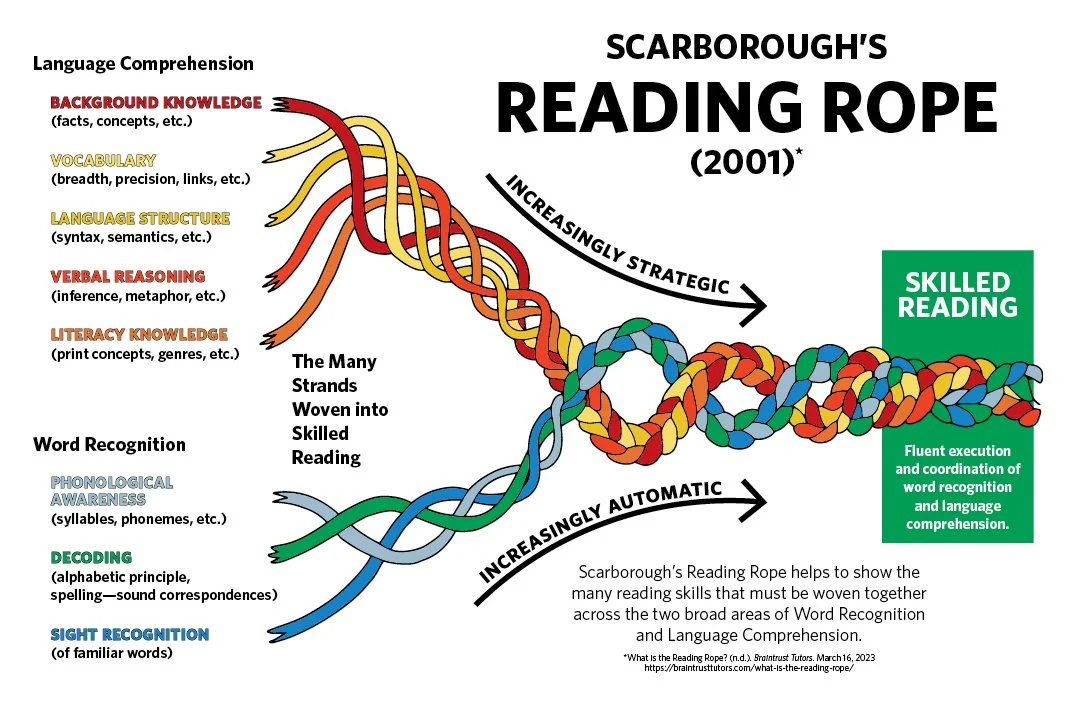
Scarborough’s model reminds us that reading is not a collection of isolated skills. It is the result of increasingly strategic interaction between:
Word recognition
Language comprehension
Poetry naturally invites this integration.
Unlike many instructional texts, poetry:
Requires attention to sound (phonology)
Encourages repeated reading (fluency)
Uses dense and layered language (vocabulary)
Demands interpretation (comprehension)
In this way, poetry is not an “extra.” It is an ideal context for developing multiple strands of reading at once.
Literacy Landmark
Spotlighting strategies and research to support all adults who are a part of a child’s reading growth.
Poetry brings multiple dimensions of skilled reading together within short, meaningful texts. With intentional instruction, a single poem can provide opportunities to strengthen sound awareness, fluent reading, language, and comprehension.
🔤 Sound & Word Recognition
Poetry makes the sound structure of language noticeable.
Rhyme, alliteration, rhythm, and repeated sound patterns invite younger readers to attend to the sounds within words. For developing readers, noticing recurring sound and spelling patterns can also reinforce connections between spoken and written language.
Research connection: Phonological awareness supports the development of word-reading skills, particularly when attention to sounds is connected explicitly to print (Ehri et al., 2001; National Reading Panel, 2000).
🗣️ Fluency & Prosody
Poetry gives students a reason to reread.
Short poems work especially well for modeled, echo, choral, and repeated reading. As students become more automatic with the words, they can devote greater attention to phrasing, expression, punctuation, and meaning.
Research connection: Guided repeated oral reading can improve word recognition, fluency, and comprehension, while prosody reflects the interaction between fluent word reading and meaning-making (Kuhn et al., 2010; Rasinski, 2012).
💬 Vocabulary & Language
Poetry makes every word matter.
Figurative language, multiple meanings, imagery, precise vocabulary, and sometimes unusual syntax create natural opportunities to examine how language works. Asking Why this word? can lead to richer discussion than simply asking students to define it.
Research connection: Robust vocabulary learning involves repeated, meaningful engagement with words, along with opportunities to discuss and use them in varied contexts (Beck et al., 2013).
🧠 Comprehension & Interpretation
Poetry asks readers to think beyond what is explicitly stated.
Readers infer, interpret figurative language, consider tone and purpose, connect ideas across lines, draw on background knowledge, and justify interpretations with textual evidence.
Research connection: Reading comprehension depends on the coordination of language, knowledge, inference, and other cognitive processes—not the application of comprehension strategies in isolation (Cervetti & Wright, 2020; Duke et al., 2021).
The important connection
These processes do not operate separately when students actually read.
A student performing a poem with meaningful phrasing is simultaneously recognizing words, processing syntax and vocabulary, interpreting meaning, and using that understanding to determine expression.
That is what makes poetry so valuable: it gives students a manageable text in which many strands of skilled reading can work together.
Resource Roadmap
Offering practical books, guides, and downloadable resources that families, teachers, and homeschoolers can use right away.
Poetry Foundation — Educator Resources
→ Find poems, audio recordings, poem guides, teaching ideas, and resources organized by grade level.
Children's Poetry Archive
→ Let students hear poetry performed aloud while exploring poems organized for children by age and theme.
Reading Rockets — Fluency Instruction & Activities
→ Explore research-informed guidance for using short texts, including poetry, for modeled and repeated oral reading.
🖋️ These resources are not sponsored. They are included because they provide useful, accessible connections between research and classroom practice.
Practical Pathways for Supporting Meaningful Reading
All strategies below can be used at home, in classrooms, or in homeschool settings.
Trail Tots (Birth–5)
Focus: Oral language, rhythm, and early comprehension
Try this:
Read simple poems and nursery rhymes aloud with expression
Emphasize rhythm, rhyme, and repetition
Invite children to join in with predictable words or phrases
Ask open-ended questions such as “What did you notice?” “How did it sound?”
Why it matters:
Rhymes and poems provide playful experiences with the sound structure of language while also building oral language and listening comprehension.
Trailblazers (Grades K–3)
Focus: Fluency and foundational comprehension
Try this:
Use echo, choral reading, and repeated reading with short poems
Notice rhyme, rhythm, and word patterns
Discuss unfamiliar or interesting words
Ask students to explain the meaning in their own words
Why it matters:
Short, engaging texts provide opportunities for meaningful rereading while students coordinate increasingly automatic word recognition with language and comprehension.
Trail Masters (Grades 4–8)
Focus: Interpretation, structure, and analysis
Try this:
Analyze figurative language, imagery, and tone
Discuss how the structure contributes to meaning
Examine how word choices affect tone
Use short written responses to support interpretation
Why it matters:
Poetry gives older readers a compact but sophisticated text through which to integrate vocabulary, knowledge, verbal reasoning, text structure, and comprehension.
Why Poetry Belongs in Reading Instruction
Poetry brings sound, language, structure, knowledge, and meaning together in an unusually concentrated form.
When students read a poem, reread it aloud, examine its language, discuss competing interpretations, and support their thinking with evidence, they are doing far more than studying poetry.
They are reading.
And when we use poetry intentionally, we give students repeated opportunities to experience something Scarborough's Reading Rope illustrates so well:
Skilled reading is not the mastery of isolated parts. It is the increasingly coordinated use of many processes in the service of meaning.
Connecting Instruction to Practice
To support this process, I created a FREE Poetry Analysis & Comprehension Routine that guides students through repeated reading, analysis, and response.
This tool helps students move from noticing features of a poem to constructing meaning from it.